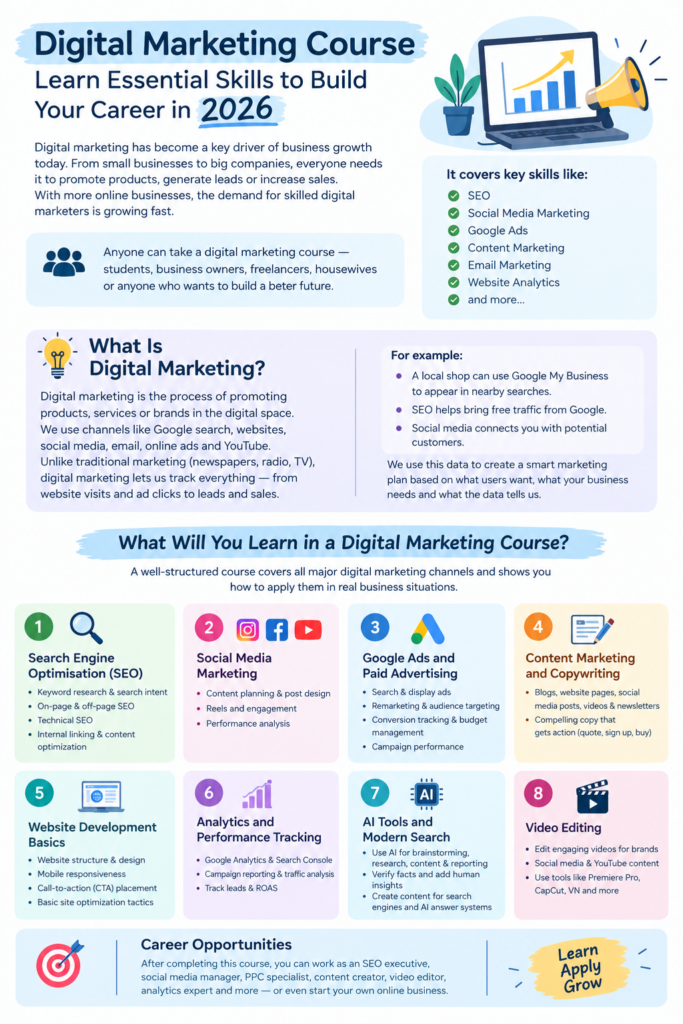
Digital marketing has become a key driver of business growth today. From small businesses
to big international companies, everyone needs digital marketing in today’s time. Whether it
is to promote a product, generate leads, or increase sales, digital marketing is needed for
every task. As more and more online businesses are coming, the demand for people with
practical marketing skills is increasing more and more.
Anyone can take a digital marketing course, whether you are a student, business owner,
freelancer, housewife, or anyone else. It includes SEO (search engine optimization), social
media marketing, Google Ads, content marketing, email marketing, website analytics, and
many other important digital marketing skills.
What Is Digital Marketing?
Digital marketing is what we do to put out products, services, or brands into the digital space.
We use channels like Google search, websites, social media (Instagram, Facebook), email,
online ads, and YouTube. As opposed to traditional marketing, which may be in newspapers,
radio, and TV, digital marketing has us tracking everything from site visits, ad clicks, info
requests, to sales. For instance,
A local shop can use Google My Business to appear when people search nearby.
SEO to drive free traffic from Google.
Social media is used for connecting with potential customers. What we learn from that is
used to develop a marketing plan that includes what users want, what your business
requires, and what the data tells us.
What Will You Learn in a Digital Marketing Course?
A well-structured course should cover the major digital marketing channels and explain how
to apply them in real business situations.
1.Search Engine Optimisation (SEO)
SEO is responsible for getting a website listed on Google through natural methods, rather
than using advertising. This process starts with keyword research, which entails knowing
how people search, their needs, and what type of information should be provided by Google.
On-page SEO follows the above; this is about optimizing the website’s content and other
on-site elements. Technical SEO comes next, which entails making a website fast,
mobile-friendly, and accessible for Google spiders or crawlers.
This is followed by the process of internal linking, where you ensure all of the website pages
are interconnected to enhance navigation for users. The last step is content optimization,
whereby you enhance your website’s content following SEO standards.
2.Social Media Marketing
Social media is about getting your business out there on various online platforms. For
example, putting out your product or service information and promotions via Instagram,
LinkedIn, Facebook, and YouTube. Also included in this is content planning, post design,
doing reels, and performance analysis. 3. Google Ads and Paid Advertising.
3.Google Ads and Paid Advertising
Paid advertising is used for reaching out to consumers through targeted marketing, which is
a large component of the course and also includes the study of search advertising, display
advertising, remarketing, ad campaign structure, audience targeting, conversion tracking,
and budget management.
Also, in terms of practice-based learning which is very helpful in how to manage ad
performance and improving campaigns without burning through the budget.
4.Content Marketing and Copywriting
Content creation, which is what content marketing is all about: you create useful info that
attracts and puts your target audience to work. This includes blogs, website pages, social
media posts, videos, and newsletters.
Copywriting is what we do to get the reader to do what we want — like ask for a quote, sign
up, or purchase a product.
5.Website Development Basics
A marketer must also know how a site functions, what it is that a certain design of the site
does to the user, and the results of that. In training, we look at site structure, home page
designs, mobile responsiveness, what we put in a call to action, and which basic site
optimization tactics to use.
6.Analytics and Performance Tracking
Analytics helps a marketer understand whether the strategy is working or not. In this,
through Google Analytics, Google Search Console, campaign reporting, and traffic analysis,
it is checked whether the strategy is working or not – how many leads were generated and
what is the ROAS.
7.AI Tools and Modern Search
These AI tools can help with the brainstorming process, research, outlines for content,
marketing campaigns, and even reporting. However, marketers need to check the facts and
provide their insights into the AI-created content before publishing it.
It is also important for students to know how to write useful content that will be understood
by search engines and AI answer systems. There is no special format of writing that will
ensure your page is cited by the AI system.
8.Video Editing
Video editing is a very important skill in digital marketing, and nowadays the demand for
video editing is very high. From small businesses to big businesses, everyone gets video
editing done. If you learn video editing properly, you can take projects from other countries
and do freelancing from home.
Who Should Learn Digital Marketing?
Digital marketing is useful for people from all walks of life, all levels of education, and all
professions.
Students and freshers: develop practical skills and get ready for entry-level opportunities.
Business owners: promote your products and services online and generate leads.
Freelancers: offer SEO, social media management, content writing, and advertising.
Working professionals: Add digital marketing skills to their existing experience.
Creators and bloggers: Increase content reach, boost audience engagement, and improve
website visibility.
You don’t need any advanced coding skills to get into digital marketing. Basic computer
literacy, communication skills, a degree of creativity, and a willingness to get your hands dirty
are about all you really need to get started.
Career Opportunities After Learning Digital Marketing
Following the relevant training and practical experience, learners may wish to consider the
following roles:
SEO Executive | Digital Marketing Executive
Digital Marketing Executive, Social Media Executive, Content Writer, PPC or Google Ads
Executive
Content Specialist SEO
Digital Marketing Analyst
Digital Marketer (Freelance)
Salary packages and job responsibilities vary with location, skills, company requirements,
and experience. Just because you took a course on your own doesn’t mean you’ll get hired.
Communication skills and the ability to explain results are practical skills that can strengthen
a candidate’s profile.
How to Choose the Right Digital Marketing Training
Institute
Comparison between various institutes should be carried out before joining to ensure that
their syllabus is compatible with your career plans.
- Syllabus up-to-date: The course should cover SEO, social media, paid advertising,
content marketing, analysis, and use of AI tools. - Practical exercises: It is also preferred that the courses include keyword research,
website analysis, content production, campaign design, and performance tracking. - Realistic projects: We see value in learning from practical examples in real-world
business settings, which will in turn give you a look at marketing strategies. - Experience of the trainer: Also, we look at the trainer’s background and teaching
approach. - Building a portfolio: We also look for a program that will develop your practical portfolio.
- Course fees & support: Find the course period, total course fees, placement assistance,
certification process & post-course support before deciding.
Why Practical Learning Matters
Learning digital marketing is not only about learning definitions. You should also know how to
research your audience, select the right channels, create content, analyze data, and
constantly refine your strategy.
For example, an activity such as improving the Google presence of a local company can be
a good practical task for a learner. You’ll need to learn keywords, optimize web pages,
develop a content plan, and monitor progress in Google Search Console.
These activities are examples of putting knowledge to work. It also makes a good addition to
one’s portfolio.
How Long Does It Take to Learn Digital Marketing?
Learning digital marketing can take a considerable amount of time, and it depends on your
timetable and the experience and quality of training of the people who are teaching you.
Learning the basics can take a few weeks or a few months, while SEO, advertising,
analytics, and campaigning can take some time, and you need to have confidence in them.
Continuous training is very important for that.
The best way to learn is to first learn the basics, then focus on different skills individually,
work on them, and learn from your own mistakes. Correct the mistakes you have made.
Frequently Asked Questions (FAQs)
1.What is a digital marketing course?
The digital marketing course is going to teach students about marketing businesses,
products, and services through the use of digital means. The course may cover elements
including SEO, social media marketing, pay-per-click, content marketing, website
optimization, etc.
2.Can novices be taught digital marketing?
Novices can start off with basic concepts and go on to develop advanced concepts. Training
and small projects may help them develop expertise in the field.
3.Is digital marketing a good career path in 2026?
Those who are keen on working in online businesses, content, analytics, and customers
should pursue a digital marketing career. The success of their careers depends on various
factors, including market demands and their skill sets.
4.Do I need coding skills to learn digital marketing?
Advanced coding is not necessary to get started. It may be helpful in some positions to know
some basic HTML and technical SEO.
5.How can I gain experience after completing training?
It could be done within your website/blogging platform by designing sample campaigns,
assisting a start-up business, interning, etc. Apply real-world examples to showcase your
abilities and label your sample and simulation projects accordingly.
Conclusion
Digital marketing combines creativity, strategy, technology, and data to help businesses
connect with their audience. It includes social media, SEO, paid advertising, analytics, and
content creation. It creates a strong base for professional growth or business promotion.
If you are choosing a digital marketing course, then focus more on practical training,
real-world assignments, and portfolio development in it. With continuous practice and a
constant willingness to learn, your skills will develop.
If you want to do a digital marketing course, you can contact us at
www.digitalmetamonk.com